

For this church:  |
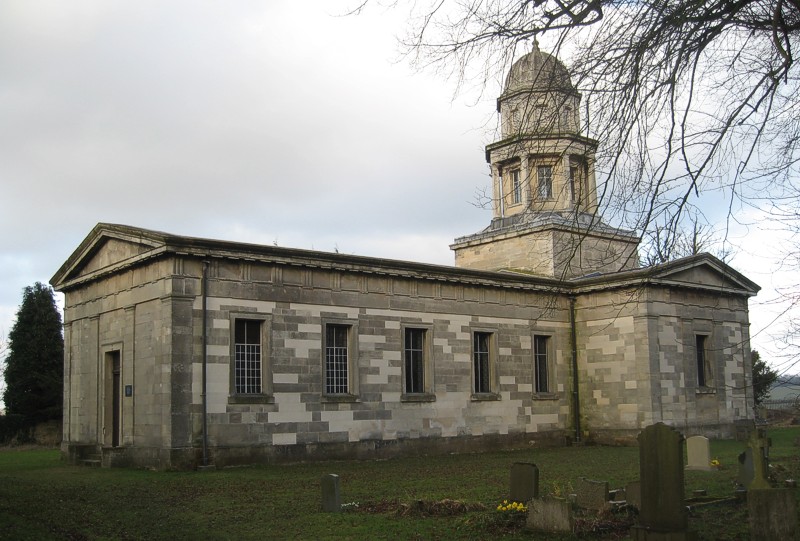 MiltonAll Saints (Mausoleum)Newark Archdeaconry Newark and Southwell Deanery IntroductionThe church was built of brick faced with stone over the period 1824-33. It was designed by Sir Robert Smirke and commissioned by the 4th Duke of Newcastle as a tomb for the Duchess, who died in 1822 after giving birth to twins. Other members of the Newcastle family are buried here. The building comprises a rectangular nave with a raised sanctuary area, a portico at the eastern end, a rotunda, north and south transepts and an octagonal lantern of two stages, with Greek Doric columns, containing two bells. The nave of has a plain west entrance whereas the mausoleum has a a four-column pedimented portico entrance to the east. The portico leads to a vestibule (with vestries on the north and south) and beyond is the rotunda with transepts on the north and south. The transepts were originally designed to be tomb chambers but the Duke changed his mind and decided they would instead house family monuments. The mausoleum became the parish church of Markham Clinton instead of West Markham All Saints, which stands half a mile away, so the latter was neglected. Then the roles were reversed in 1949 so the mausoleum started to decay and was vandalised. A recent restoration has revived interest in this individual building after the Redundant Churches Fund (now the Churches Conservation Trust) took over in 1972. There is a medieval-style memorial for the 4th Duke (d1851) and a plain mural tablet for Joseph Denman (d1863), but the main attraction is the marble monument by Sir Richard Westmacott for Georgina Elizabeth, Duchess of Newcastle and her twin babies. It is of great regret this family mausoleum suffered continuing acts of vandalism during the late 1960’s resulting in the total desecration of coffins belonging to the family including the fourth, fifth and sixth Dukes of Newcastle. Considerable damage was also occasioned to the various memorials and monuments including one to Georgiana Elizabeth, 4th Duchess of Newcastle. Following some considerable consultations between representatives of the Newcastle Family, the Bishop of Southwell and the National Trust’s Historic Building Committee, it was agreed to temporarily move the monument, along with the sculptured wall relief incorporating the death mask of young Anna Maria to Clumber. Once at Clumber, the structure was repaired, cleaned and placed in the north transept of the chapel where it remained for some years. ‘It is a clever combination of church and mausoleum’, Pevsner wrote of the building. An information board in the churchyard tells how, in foggy weather in the early hours of 3rd December 1943, a returning Lancaster bomber crashed very near to the church, killing six of the crew. Particular thanks to Amy Calladine and Andy Nicholson for research on this entry |
Introduction | Location | History | Archaeology
Fittings | Glass | Organ | Bells | Clock | Stonework | Monuments | War Memorial | Churchyard
References | Pictures | Plans | Listing Description | List of Incumbents | Parish page
Project: Home | Index | About | People | What's new | Resources
 |  |  |  |