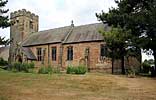
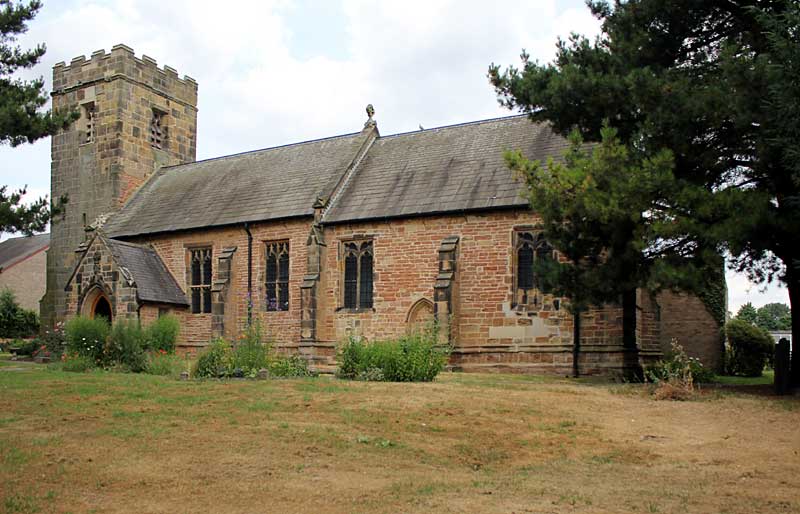
 Bilborough Bilborough
St Martin
History
There is no mention of either a church or a priest in Bilborough in the Domesday Survey of 1086, but this does not rule out the possibility
that there was one in the parish.
The earliest reference to a priest here is in a grant of land dating from c.1200: Hugh, parson of Bilborough, appears in the list of witnesses.
The ecclesiastical taxation assessment of 1291/2 gave the clear annual value of Bilburgh church at £4 0s. 0d and recorded that it was dedicated to Saint Cuthbert.
In 1341 the Nonae rolls record that the church was taxed at 6 marks (£4), that the ninth of sheaves, lambs and their fleeces were worth 54s. a year at true value and no more, and that 20 acres of arable land belonging to the church were worth 6s. 8d. a year and the small tithes and mortuary dues were worth 19s. 4d. per year.
The church appears again in the 1428 subsidy of Henry VI where its historic annual valuation of £4 (6 marks) is confirmed and the applied subsidy of 6s. 8d. affirms that there had been no change in value since 1291.
In the same year Robert Strelley, patron of Bilborough, petitioned that neighbouring Broxtowe should be united with Bilborough because of the destruction of the houses, death and movement of the inhabitants and the infertility of the fields made it impossible to support a priest there. Broxtowe and Bilborough parishes were eventually united by decree of Archbishop Booth on 26 April 1458.
In 1601 the churchwardens of Bilborough presented the following to the Archdeaconry of Nottingham: 'the desks of our church were bad, [but] now they are in making new, but not yet finished; the communion is ministered thrice a year and no oftener, by reason that our parish is very small and not above 40 communicants in the whole parish.'
Phillipp Olde of the parish of Nuttall [Nuthall] was reported by the churchwardens in 1603 'for that he came into the churchyard of Bilborough on 13 May and did most "ungodliely", unreverently and unseemly abuse and scold against Mr Lowe, parson, because he would not lend him 40s.'
Also in 1603 a series of questions was sent out to each parish on the orders of King James I with the purpose of providing statistics relating to the clergy and number of recusants and communicants. The questions in summary were:
1. The name of the incumbent and his degree, if any.
2. Whether he held more than one benefice and the value of each benefice in the king’s book.
3. The distance between benefices where more than one was held.
4. The number of recusants (men and women) in each parish.
5. The number of communicants and non-communicants in each parish.
The churchwardens of Bilborough gave the following reply:
1. our minister is no preacher, but a 'cuntrethe Scholler';
2. he has only one benefice and the valuation is £3;
3. he has only one;
4. recusants none;
5. communicants 52, those that did not communicate of lawful years, none.
In 1638 the churchwardens present the following: the parsonage house is very ruinous and ready to fall down in the default of Mr Watson the parson; the chancel is not even[ly] paved in the floor in the default of the said Mr Watson; Thomas Smith and wife of Broxtowe for popish recusants; the seats in the church are not fully made decent in the bottoms.
The churchwardens presented the following in 1641: 'Mr Raphe Watson, parson, because we have had no prayers at all on 9, 16 or 23 May last, no prayers at all on 1 and 8 August last, and no prayers at all on the 3rd of this instant October, all these days being Sabbath days; we have had no prayers in the afternoon of 10 October; the parsonage house, walls and floors are down and no repair has been made since he came to the cure, but [he] suffers 'bease' [beasts] and swine to lie and harbour in the same; the chancel is out of repair, and the glass windows are down; "he bows and cringes to the Alter".'
In 1641, by order of the House of Commons, all adult men were asked to swear an oath of allegiance to the Protestant religion. Lists of their names were compiled and sent back to Parliament. The return for Bilborough, written by Josias Aldered, is notable by the reaction he got at the church:
'I came by the comand of John Digby Esq hie sheriffe of the said County: unto the Church of Bilbrough aforesaid to tender the protestation unto the parishioners there: where the day and yeare above wrytten [6 March 1641/2] I found in the Church yard one Imanuell Knutton Clerk: Francis Hill: Richard Hill: William Tomline and Simion Wightman who shutt the Church doore or procured it to bee shutt against mee: and he said William Tomline and Symion Wightman said publickly they would take noe protestation at mee.'
In 1718 repairs were carried out to the church. The chancel wall was partly pulled down and rebuilt and the roof repaired and to pay for the
work Dr Robert Gray's charitable bequest of £20 was appropriated.
An Order relating to church buildings, furnishings and supplies was issued in 1719. The churchwardens were instructed to 'repair the out walls and windows by pointing and glazing where wanting, and the pavement likewise, and whitewashing it all over within, and to certify that their books, vestments and utensils are all perfect (nobody being here to show them to the Archdeacon)'. The following printed items were also to be supplied: 'table of the prohibited degrees of marriage; the Lord's Prayer, the Creed; the King's Arms' and a lock for the poor man's box and a hearse cloth were to be supplied.
At the time of Archbishop Herring's Visitation in 1743 the rector, the Rev William
Goodday, complained that he could take services only on alternative weeks in
Strelley and Bilborough, 'the smallness of their incomes prevents a constant
attendance'. He celebrated Holy Communion four times a year, usually with seventeen
attenders. The income of the living was £37 6s 8d in 1788.
Twenty-three years later the Rev William Goodday was still the incumbent and appeared and exhibited at Archbishop Drummond's Visitation. He stated that there were 30 families in the parish, one of which was 'a dissenter of Presbyterian denomination.' He lived at Strelley, 'there being no building of any kind on the glebe land at Bilborow,' had no curate and conducted services at Strelley and Bilborough every Sunday, alternating between morning and afternoon. He observed that 'the parishioners consist chiefly in colliers and coal carriers, and are very remiss in sending their children to church to be catechised.' He administered the sacraments four times annually in his churches. The number of communicants were about 81, 'twenty of whom usually receive; eleven communicated at Easter ... 1763.'
The parish register reports that in August 1787 a 'new pillar [was] erected on the northern side of Bilborow Chancel for the support of it [and] the inside white-washed'.
A curious feature of the chancel was the wooden chancel arch; there are a
number of entries in the parish registers for the renewing of the 'Side Trees' in
the chancel. These were renewed and the chancel re-roofed in August 1763 and
again in 1791, when the cost of re-roofing was £12 11s 9d,
and the total cost over a period of four years amounted to £17 19s 11d.
Bilborough was said in 1796 to have only seven inhabited houses.
William Stretton,
writing about 1819 or 1820, mentions a wooden
chancel arch, which at that time was broken down, and that the nave and chancel
were of the same width. A new floor was laid, probably only in the nave, at
about that time. There were then five two-light windows in the nave and two
two-light and in the east three light windows in the chancel. The latter, Stretton
says, was 'Coeval with the church angle buttresses'. Reference is made to the
Gothic south door, but no porch is mentioned; to the old oak seating; the Arms
of George I (these were replaced by the Arms of George IV at a later date);
and a north door with a pointed arch, since built up when the church was extensively
renovated in 1833. The west window may date from this restoration.
A new rectory
was built to the west of the church in 1842 at a cost of about £2,000.
At the time of the 1851 religious census the population of Bilborough had
grown only to 255. The rector, the Rev W. J. Hobson, was also responsible for Broxtowe Hall. The church could seat
130, and according to Hobson's return there were 153 (93 adults, 60 Sunday
scholars) at the afternoon service in St Martin's. In his three-month
averages he included the seating capacity of both Bilborough and Strelley, and gave figures
of 145 for morning and 195 for his afternoon congregations.
The church assumed its present appearance after a restoration under the faculty dated 24 October 1887, that
was completed the following year. The faculty granted to the Rev Benjamin Williams, Rector, the Parishioners
and Wardens (Charles Hall and John Burton) allowed them:
'To take off the present roof, take down the north and
part of the east wall of the chancel and defective buttresses and the west
side of the porch and rebuild on secure foundations. To take down the gallery
and brickwork blocking the tower arch and the brick chimney in the tower.
To build a new chancel arch, vestry arch and heating chamber, to raise the
sill of the east window as shown on plans. To erect new roof in oak, coping
stones to the tower, new bell frame and new floor to the belfry. To take
out all vegetable soil from the church and raise the floor and concrete and
tile same. To reseat. To move the font, to refix the pulpit. To install a
new hot air heating system and to glaze all the windows. That the whole will
cost about £1400.
That tombstones may be removed and vaults but must be replaced.'
The sum spent exceeded the estimated cost by approximately £135 and
the faculty was infringed in regard to the monuments. The plans for the restoration
were drawn up by John E. Newbury of London, Surveyor, who received for his work £75 16s. 0.d
plus £15 2s. 9d. for extra plans and expenses; the work was carried
out by W. Smith and A. Lunn of Newark, under the supervision of John
Allan, Quantity Surveyor, who received for his work between 1 October 1887
and 28 April 1888 eight payments totalling £47 14s. 0d. including
expenses.
By early 1902 the rector, the Rev Benjamin Williams, was in financial difficulties and in February received a bankruptcy order. At the Nottingham Bankruptcy Court in April 1902 he declared that his liabilities were £214, and his free assets £26. In connection with that statement there was a claim for dilapidations, which had not been included. He was liable for dilapidations in regard to the various farms, etc., attached to the benefice, and he thought the amount of those dilapidations would be at least £250. Williams attributed his plight to heavy expenses connected with maintaining the rectory and its grounds. 'Illness in his family was also one of the causes of his insolvency' and he also identified the reduction in the value of the living due to agricultural depression. His bankruptcy was annulled in 1906 after he had paid back all his creditors. After 56 years as Rector of Bilborough and Strelley Williams resigned in September 1927.
In 1912 the benefice was worth £195, the church could accommodate 143, there were 57 on the roll of the church day school and 35 on the roll of the Sunday School. From September 1911 to September 1912 there had been three baptisms and seven confirmations.
The patronage of the church has always been vested in the lords of the manor,
the de Strelleys and then the Edges with only very occasional exception. Twice
the Crown appointed, until 1927 when the patronage passed to the Society for
the Maintenance of the Faith.
In 1932 Nottingham extended its boundaries and Bilborough parish became part of the city. By 1938 the city Corporation had built council housing over much of the east part of the parish and the houses were approaching the old village. The population increase led, in January 1934, to a piece of land on the eastern side of the parish being taken
to help form the new parish of St Margaret Aspley, and in February of
the same year another piece was lost on the north side when the chapel of ease,
Christ Church Cinderhill, became a parish in its own right.
Shortly after the end of the Second World War a panel consisting of the rector, Father W. H. Marshall, and several parishioners invited members of the Midland Regional Designers' Group to submit designs for a mural in the church. They selected the entry by Evelyn Gibbs depicting the Annunciation. The design shows the Angel Gabriel informing Mary that she will give birth to Jesus, the Son of God. Unusually, the scene is set in Bilborough and shows local landmarks, including St Martin's Church, in the background. The mural was completed by Gibbs and Claude Price in November 1946.
A chapel of ease dedicated to St Martha with a curate's house was built
on Frinton Road, Broxtowe, which became a parish in 1952. St Martin's
also lost the south side of the parish to the new parish of St John in
1959.
In 1972 a major enlargement of the church took place. Most of the
north wall of the chancel was removed and a large extension to the church, increasing
the seating capacity to 330 and including a hall and various offices, was built in brick.
This addition to the church cost £18,000. The architect was the rector's brother, Colin Shewring, and the extension was consecrated by Bishop Denis Wakeling on 20 November 1972.
During these alterations the mural monument to Edmund Helwys of Broxtowe was
moved from the north chancel wall to the south and a suspended pine ceiling was built in the chancel which concealed both the Victorian barrel-vaulted roof and Gibbs' mural, the lower sections of which were painted over with emulsion.
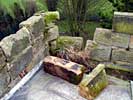 The tower parapet The tower parapet
in 2011 |
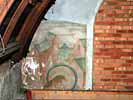 A surviving section of A surviving section of
the Gibbs' mural (2011) |
By the early 21st century the medieval nave and tower had fallen into serious disrepair. In 2009 a Repair Grant for Places of Worship in England was secured from English Heritage and the Heritage Lottery Fund and over the period 2011-12 the tower was restored, including a new roof and parapet, the nave re-plastered and decorated, and new electrical and drainage systems installed.
At an early stage of the repair work it was discovered that Evelyn Gibbs' mural had survived above the suspended chancel ceiling. After consultation with English Heritage a conservation report was produced and plans for restoration of the mural made. A Heritage Lottery Fund grant was awarded in 2012 to fund the restoration of the mural, the barrel-vaulted ceiling and the east window as part of the Hidden Treasures Project. Work started in 2014 and the also included the installation of under-floor heating, new stone floor tiles and a new lighting system.
| 


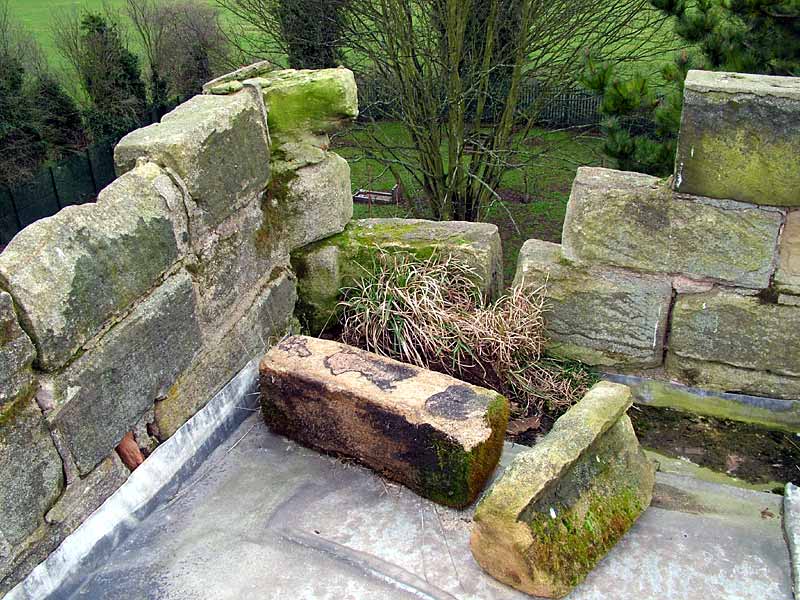 The tower parapet
 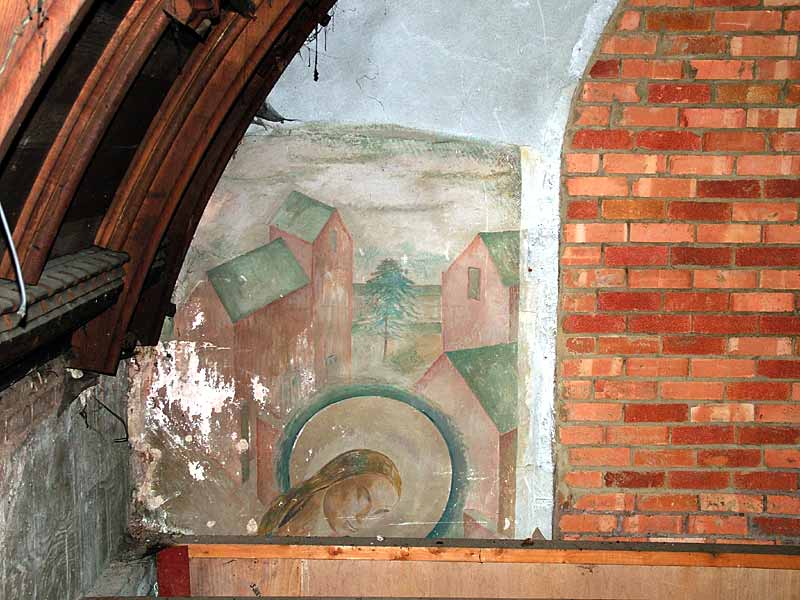 A surviving section of


