 Milton Milton
All Saints (Mausoleum)
History
The hamlet of Milton is within the parish of West Markham. It lies on the east bank of the River Idle, about a kilometre north-west of the village of West Markham.
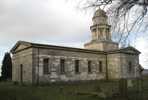
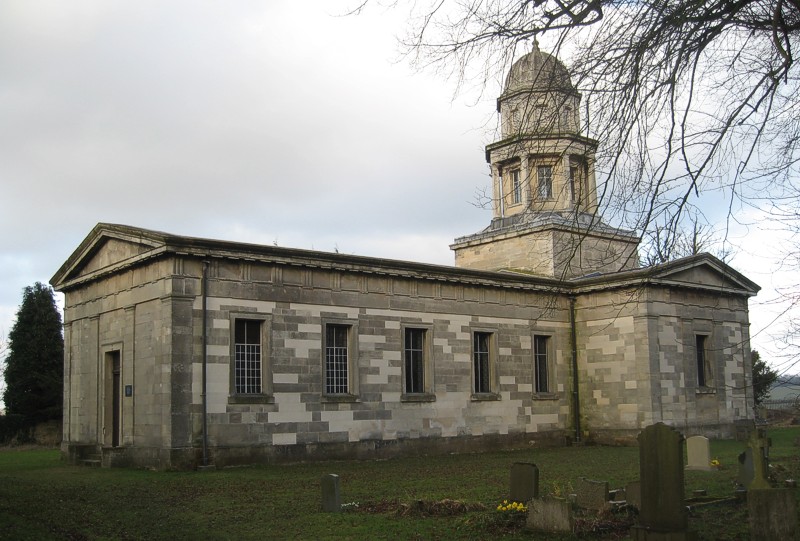
Milton Mausoleum was built in 1824-32 by Henry Pelham, the 4th Duke of Newcastle (1785-1851), to the design of Robert Smirke. Smirke was the celebrated architect of the British Museum, Somerset House and the Royal Mint. He was the favoured choice of the Tory establishment and had previously carried out work for Sir Robert Peel. The mausoleum was built as a tomb for the Duchess of Newcastle, Georgiana Elizabeth, who died in childbirth, aged just 33 in 1822. The couple had been married in 1807 and Georgiana had a baby almost every year from this point on. At the beginning of 1822, the couple had eleven surviving children. In May of that year, their eldest daughter, Anna Maria (1808-1822), fell ill and died. Four months later Georgiana gave birth to twins, one stillborn and the other seemingly healthy. Tragically, both Georgiana and her surviving baby boy became ill and died shortly afterwards.
Initially, the Duke had planned to extend the family vault at Bothamsall church. However, by early 1823 he was working with Smirke on a different scheme and on 28 February 1823 he wrote in his diary:
‘… took Mr Smirke to West Markham where there is a very bad church and I mean to move it to a central position between west Markham, Milnton [Milton] and Bevercotes. Afterwards I shall remove the parsonage house and place it near the church. Mr Smirke approves of my plan and of the change from Bothamsall to this place’.
The Duke commissioned the sculptor Richard Westmacott, who had made the death mask of the young Anna-Maria, to complete a marble monument to his late wife.
Only a handful of Nottinghamshire churches have mausoleums. What is especially unusual about the mausoleum at Milton is that a parish church was specifically incorporated into the design. The parish church is divided from the transepts and eastern end by a wall containing a small door. The whole of the ‘chancel’ end is the mausoleum.
The building itself is modelled on a classical design with four columns supporting a pediment. It was erected to emulate a Greek Doric temple, with a portico at the east end, and an octagonal tower rising from the centre crowned by a cupola containing three bells. It is thought to have been based on a temple that Smirke visited on the banks of the River Ilyus in Athens. The building stands at the brow of a hill and can be seen for miles around.
The digging of the foundations began on 24 May 1824 with the foundation stones being laid in June. The mausoleum was made from local Roche Abbey stone and the brick came from brick kilns in Tuxford.
When the building of the mausoleum was completed in 1833 it became the parish church, replacing the old church in West Markham. It was consecrated on 27 December 1833 by the Archbishop of York. Its dedication, All Saints, was the same as the old church that it replaced. The parish was subsequently renamed Markham Clinton.
Following its completion, the Duke wrote in his diary that ‘nothing could be more successful than all the arrangements… the Church must have cost me above £10,000 and the parsonage and grounds full and above £3,000 more’.
Parishioners entering the church would have used the plain west entrance. Immediately beyond this entrance is an inner porch above which is a small gallery for singers reached by a set of stairs. The actual mausoleum area, which occupies the crossing, transepts and chancel, was accessed through the grand portico at the east end of the building.
The burial vault lies under the floor of the body of the church. It measures 20 m in length by 5.2 m in width and is divided into six compartments lengthways and three in height. Red brick is used throughout the vault with heavy stone slabs to rest the coffins on. There are 36 recesses with room for two coffins in each.
In the centre of the nave floor there is a stone with two iron rings embedded in it. This leads down into the mortuary vaults below. As both labour and machinery were required for raising the stone, a scale of fees was decided upon. The vicar was paid 15 shillings and the churchwardens 5 shillings each at a burial. The machinery to open the vault consisted of two large screw jacks made of cast iron with brass bearings and large diameter wheels at the lower end of each jack to screw them up and down. A large board made of oak lay across the top of the jacks to support the coffin.
The vicarage house joins the churchyard and is an elegant building in the Swiss style erected by the Duke and later enlarged in 1839.
The first burial at the mausoleum took place on 24 October 1834 when the Duke's mother, the Dowager Duchess, was laid to rest in the vault.
Eighteen months later Georgiana and other members of his family were transferred from the vault at Bothamsall church to the mausoleum. The entry in the Duke’s diary for 27 March 1836 records:
‘By a letter from E. Dawkins [vicar of Markham Clinton] I learn that he has executed my commission, and the loved and honoured remains of my dearest wife and 4 children and my dear sister Charlotte have been moved from Bothamsall and have been deposited in the vault of Markham Clinton Church.’
On 5 December 1839 the Duke discussed the site for Georgiana’s monument with the sculptor, Sir Richard Westmacott; four days later the monument was installed in the south transept of the mausoleum.
The white marble monument depicts the Duchess in a reclining posture holding her two infants on her lap. A slab of white marble overlooking the monument shows the finely executed outline of an angel. This is thought to represent the death mask of the daughter of the Duke and Duchess, Anna Maria, coming down to guide her mother and brothers to heaven. Anna had died earlier in 1822 and was temporarily buried in Marylebone Church, London.
The 4th Duke of Newcastle died at Clumber on 12 January 1851. The Nottingham Journal provided a description of the coffin in which he was placed:
‘A few days after death, his Grace's remains were placed in a shell of Spanish mahogany, lined with rich white satin ; this was ultimately placed within a leaden coffin, and encased in the outer coffin of Spanish mahogany, covered with crimson Genoa velvet, having eight massive handles, with a coronet over each: the lid studded with gilt stars, and having upon it the breastplate, with a coronet above and below. These were made by his Grace's tradesmen, at Clumber. Upon the plate was the following inscription:—“Henry Pelham Pelham Clinton, Duke of Newcastle and Earl of Lincoln, Knight of the most noble Order of the Garter, eldest son of Thomas, third Duke of Newcastle, and Anna Maria, fifth daughter of William, second Earl of Harrington, born 30th January, 1705, died 12th January, 1851.” The above was surmounted with the Noble Duke’s arms, supporters, crest, coronet, &c.’
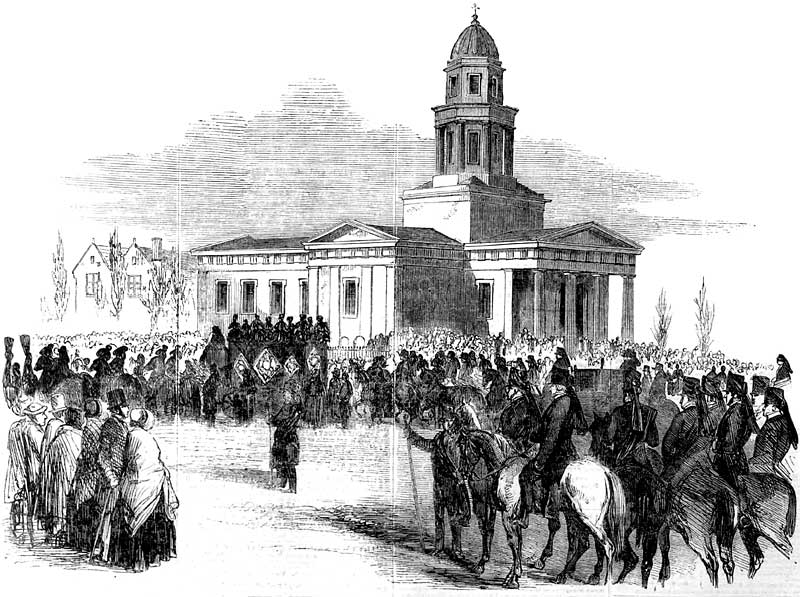
 Funeral of the 4th Funeral of the 4th
Duke of Newcastle |
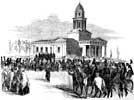
His funeral was held at Milton Mausoleum on 21 January. In addition to family mourners over 300 tenants on horseback formed part of the impressive funeral procession that extended a mile and a half long along the route from Clumber Park to Markham Clinton.
In February 1851 there was outrage when the mausoleum was broken into and 20 yards of black cloth ‘hung round the pulpit and reading-desk, the communion-table, and other parts of the church, on the occasion of the funeral of the Duke of Newcastle' was stolen. A reward of £10 was offered by Nottinghamshire Constabulary ‘for the apprehension of the depradator’.
The vicar of Markham Clinton, the Rev Edward Henry Dawkins, provided the return for the Census of Religious Worship in 1851. He stated that Divine Service on the morning of 30 March had a general congregation of 65 and 20 Sunday scholars. Dawkins reported that the average number of attenders was 90 for the morning service and 120 for the afternoon.
Two other Dukes of Newcastle were buried here: the 5th Duke on 27 October 1864 and the 6th Duke on 28 February 1879.
The church was repaired in 1883 at a cost of £400.
In 1889, the 7th Duke of Newcastle completed his new church on the family estate of Clumber Park. This became the focus of family worship and the old mausoleum was left to decay.
In the 1920s the vicar, the Rev George Crookenden, corresponded with the 7th Duke about re-seating the church with new benches. An estimate was received from A. R. Mowbray & Co. but the cost was too high so the order was postponed. Other correspondence related to the maintenance of the building: of particular concern was the dome on the lantern which had defective stonework and it was suggested that a wooden floor or ceiling was inserted to make it safe.
In 1930 Crookenden
began work on the restoration of All Saints, West Markham, with the intention of instituting it as the parish church once more. He appealed for funds and some work was completed but the mausoleum continued as the place of worship for the parish.
In the early hours of 3 December 1943, a returning Lancaster bomber crashed near the church killing all six crew members. A stone in the churchyard commemorates the tragic accident.
In 1945, the Rev John Hooker, vicar of Tuxford, took over Markham Clinton after the death of the Rev George Crookenden and the two parishes became a joint living. In 1949 he began another restoration of the old Anglo-Saxon building which was, this time, successfully completed.
The same year, representatives of the living Duke of Newcastle let it be known that he had ‘other responsibilities’ and could no longer contribute to the upkeep of the mausoleum. The villagers that lived nearer the older church petitioned the Bishop that the ancient church should be restored to its rightful office. In view of this action, the Chancellor of the Diocese held a Consistory Court in the mausoleum in September 1949. The evidence was heard and eventually an official verdict was given in favour of the restoration of the old parish church. This took place on 28 October 1949.
An inspection of the mausoleum in November 1971 to investigate subsidence revealed that the burial vault had been broken into and coffins smashed open. The police concluded that the desecration could have taken place at any time since 1946 when the vault was finally sealed at the same time as the church was closed.
The Newcastle memorials were badly damaged by vandals in the 1960s. The mausoleum at this time was described as ‘virtually gutted and the only thing of value inside the church is this monument [to Georgiana] … The left arm of the Duchess’s effigy is broken off and lying on the mattress.’ Following discussions with the National Trust the monument was taken to Clumber Park where it was restored. It spent several years in the chapel there until it was returned to West Markham in the late 1980s.
The building, now simply a mausoleum, was rescued in 1972 when the Redundant Church Fund (now the Churches Conservation Trust) took over the guardianship of the building.
| 


 Funeral of the 4th


